Problem Description
Placement optimization is an important phase in designing circuits. Two main aspects to optimize in this problem are maximizing space utilization and wirelength minimization.
Obviously, this problem is far outside the domain of this homework due to its sheer complexity. Typically, auto-placement algorithms are used to solve this problem, such as PCB design or CAD software.
Due to the problem’s complexity, such programs utilize linear optimization only partially, to eliminate solutions which are definitely non-optimal. The placement problem otherwise is solved via many trial-and-error iterations, as well as greedy algorithms & simulated annealing methods. This problem is largely connected to graph theory, in which increasing the number nodes hastily leads to a further increase in complexity in order to unambiguously determine exact, optimal values.
Taking all this into account, a much simplified version of this problem will be considered. Effectively reducing the problem to component placement.
Data Sources
It would have been great to consider data from a real chip to optimize, but solving such a problem for real-world values using a reduced linear programming algorithm would not yield any meaningful results since we have to use too many variables to get anything proper.
Therefore, I introduce random values that I have hand-picked in order to not make the optimization problem too trivial.
Mathematical Model
I will try to introduce as comprehensive of a list of parameters and restrictions as possible, while keeping everything relatively simple. Let’s reduce the problem to minimizing the distance between circuit components, without any additional optimizations (like wires, their density, buffers between components, temperature regulations, location of connection, etc.) because that would exponentiate the difficulty greatly. We’ll have enough with many different constraints we’ll have to consider anyway.
This homework is largely based on this article.
Variables
, — and coordinates of component ’s bottom-left corner
— 1 if component is assigned to bin and layer , 0 otherwise
— number of components assigned to bin and layer
— 1 if layer is active in bin , 0 otherwise
— 1 if component is to the left of component , 0 otherwise
— 1 if component is below component , 0 otherwise
, — bonus variables for non-overlap conditions
— 1 if components and are in the same bin, 0 otherwise
— bonus variable, linearized product of and
— maximum difference in component positions
— penalty to optimize placements within the component
— large constant for Big-M method, creating an artificial solution in this linear programming problem
, — width and height of the circuit board
, — width and height of component
, — width and height of each of the bins
— packing factor
, — orientation parameters
— all components
— all bins
— all layers
Constraints
Let’s introduce all the constraints with a brief explanation of what in the world they are.
Components shall stay within the boundaries of the circuit board
There shall be a limit for the total components per bin based on packing density
Theta tracks components assigned to each bin-layer combination
Each component shall be assigned to exactly ONE bin and ONE layer
Each bin shall use exactly ONE active layer
Technical constraint to link continuous with binary variables
Component-bin assignments shall be sufficient
Components shall fit within their assigned bin boundaries
Components shan’t overlap horizontally
Component shan’t overlap vertically
At least one non-overlap condition shall be active
Components shan’t be both left and right of each other
Components shan’t be both above and below each other
And the list of all the constraints together expanded for all coordinates:
Solution
Since solving this problem would be an absolute nightmare in Excel, I use Python instead.
!pip install pulpimport numpy as np
import pulp
from typing import List, Tuple
class Driver:
def __init__(self, components: List[Tuple[float, float]],
bin_width: float, bin_height: float,
Z: List[Tuple[float, float, float, float]],
L: List, f: float, w_o: float, h_o: float):
self.C = components
self.w = bin_width
self.h = bin_height
self.Z = Z
self.L = L
self.f = f
self.w_o = w_o
self.h_o = h_o
self.n_components = len(components)
self.n_bins = len(Z)
self.n_layers = len(L)
self.problem = pulp.LpProblem("CircuitOptimization", pulp.LpMinimize)
def build_model(self):
x = pulp.LpVariable.dicts("x", range(self.n_components), lowBound=0)
y = pulp.LpVariable.dicts("y", range(self.n_components), lowBound=0)
mu = pulp.LpVariable.dicts("mu",
[(i, z, l) for i in range(self.n_components)
for z in range(self.n_bins) for l in range(self.n_layers)],
cat=pulp.LpBinary)
theta = pulp.LpVariable.dicts("theta",
[(z, l) for z in range(self.n_bins) for l in range(self.n_layers)],
lowBound=0)
omega = pulp.LpVariable.dicts("omega",
[(z, l) for z in range(self.n_bins) for l in range(self.n_layers)],
cat=pulp.LpBinary)
alpha = pulp.LpVariable.dicts("alpha",
[(i, ip) for i in range(self.n_components)
for ip in range(self.n_components) if i != ip],
cat=pulp.LpBinary)
beta = pulp.LpVariable.dicts("beta",
[(i, ip) for i in range(self.n_components)
for ip in range(self.n_components) if i != ip],
cat=pulp.LpBinary)
M = 1000
self.problem += pulp.lpSum([x[i] + y[i] for i in range(self.n_components)])
###############################################
for i in range(self.n_components):
w_i, h_i = self.C[i]
self.problem += x[i] <= self.w - w_i
self.problem += y[i] <= self.h - h_i
###############################################
for z in range(self.n_bins):
self.problem += pulp.lpSum([theta[z, l] for l in range(self.n_layers)]) <= self.n_components
###############################################
for z in range(self.n_bins):
for l in range(self.n_layers):
self.problem += theta[z, l] == pulp.lpSum([mu[i, z, l] for i in range(self.n_components)])
###############################################
for i in range(self.n_components):
self.problem += pulp.lpSum([mu[i, z, l] for z in range(self.n_bins)
for l in range(self.n_layers)]) == 1
###############################################
for z in range(self.n_bins):
self.problem += pulp.lpSum([omega[z, l] for l in range(self.n_layers)]) == 1
###############################################
for z in range(self.n_bins):
for l in range(self.n_layers):
self.problem += theta[z, l] <= M * omega[z, l]
###############################################
total_mu = pulp.lpSum([mu[i, z, l] for i in range(self.n_components)
for z in range(self.n_bins) for l in range(self.n_layers)])
aux_theta_omega = pulp.LpVariable.dicts("aux_theta_omega",
[(z, l) for z in range(self.n_bins) for l in range(self.n_layers)],
lowBound=0)
for z in range(self.n_bins):
for l in range(self.n_layers):
self.problem += aux_theta_omega[z, l] <= theta[z, l]
self.problem += aux_theta_omega[z, l] <= M * omega[z, l]
self.problem += aux_theta_omega[z, l] >= theta[z, l] - M * (1 - omega[z, l])
self.problem += total_mu >= pulp.lpSum([aux_theta_omega[z, l]
for z in range(self.n_bins) for l in range(self.n_layers)])
##############################################
for i in range(self.n_components):
for z in range(self.n_bins):
for l in range(self.n_layers):
x_bin, y_bin, w_bin, h_bin = self.Z[z]
w_i, h_i = self.C[i]
self.problem += x_bin <= x[i] + M * (1 - mu[i, z, l])
self.problem += x[i] <= x_bin + w_bin - w_i + M * (1 - mu[i, z, l])
self.problem += y_bin <= y[i] + M * (1 - mu[i, z, l])
self.problem += y[i] <= y_bin + h_bin - h_i + M * (1 - mu[i, z, l])
##############################################
same_bin = pulp.LpVariable.dicts("same_bin",
[(i, j) for i in range(self.n_components)
for j in range(i+1, self.n_components)],
cat=pulp.LpBinary)
for i in range(self.n_components):
for j in range(i+1, self.n_components):
for z in range(self.n_bins):
for l in range(self.n_layers):
self.problem += same_bin[i,j] >= mu[i,z,l] + mu[j,z,l] - 1
w_i, h_i = self.C[i]
w_j, h_j = self.C[j]
self.problem += x[i] + w_i <= x[j] + M * (1 - alpha[i,j] + 1 - same_bin[i,j])
self.problem += x[j] + w_j <= x[i] + M * (1 - alpha[j,i] + 1 - same_bin[i,j])
self.problem += y[i] + h_i <= y[j] + M * (1 - beta[i,j] + 1 - same_bin[i,j])
self.problem += y[j] + h_j <= y[i] + M * (1 - beta[j,i] + 1 - same_bin[i,j])
self.problem += alpha[i,j] + alpha[j,i] + beta[i,j] + beta[j,i] >= same_bin[i,j]
return x, y, mu, theta, omega
def solve(self):
x, y, mu, theta, omega = self.build_model()
self.problem.solve(pulp.PULP_CBC_CMD(msg=1, timeLimit=60))
if self.problem.status == pulp.LpStatusOptimal:
results = {
'status': 'Optimal',
'objective': pulp.value(self.problem.objective),
'placements': [],
'assignments': [],
'bins_used': set()
}
for i in range(self.n_components):
x_val = pulp.value(x[i])
y_val = pulp.value(y[i])
w_i, h_i = self.C[i]
results['placements'].append((i, x_val, y_val, w_i, h_i))
for z in range(self.n_bins):
for l in range(self.n_layers):
if pulp.value(mu[i, z, l]) > 0.5:
results['assignments'].append((i, z, l))
results['bins_used'].add(z)
return results
def display_optimal_variables(self, n_components, n_bins, n_layers):
print("ALL OPTIMAL VARIABLE VALUES")
for var in self.problem.variables():
print(f"{var.name} = {var.varValue:.4f}")
print(f"Total variables: {len(self.problem.variables())}")
print(f"Objective value: {pulp.value(self.problem.objective):.4f}")
if __name__ == "__main__":
components = [(2, 2), (2, 3), (3, 2), (2, 2), (1, 4), (3, 1)]
bin_width = 8
bin_height = 6
bins = [(0, 0, 4, 6), (4, 0, 4, 6)]
# This is intentionally made trivial
layers = [0]
f = 1.0
w_o = 1.0
h_o = 1.0
print(f"Components: {components}")
total_component_area = sum(w*h for w,h in components)
total_bin_area = sum(w_bin * h_bin for x_bin, y_bin, w_bin, h_bin in bins)
print(f"Total component area: {total_component_area}")
print(f"Total bin area: {total_bin_area}")
print(f"Area utilization: {total_component_area/total_bin_area:.1%}")
print(f"Bins: {len(bins)}")
solver = Driver(components, bin_width, bin_height, bins, layers, f, w_o, h_o)
results = solver.solve()
print("\nSolution Status:", results['status'])
if results['status'] == 'Optimal':
print("Objective Value:", results['objective'])
print("\nComponent Placements:")
for placement in results['placements']:
i, x, y, w, h = placement
print(f"Component {i}: pos=({x:.1f}, {y:.1f}), size={w}x{h}")
print("\nComponent Assignments:")
bin_usage = {}
for assignment in results['assignments']:
i, z, l = assignment
print(f"Component {i} -> Bin {z}, Layer {l}")
if z not in bin_usage:
bin_usage[z] = 0
bin_usage[z] += 1
print(f"\nBin usage: {bin_usage}")
print(f"Bins used: {len(results['bins_used'])}")
solver.display_optimal_variables(solver.n_components, solver.n_bins, solver.n_layers)Components: [(2, 2), (2, 3), (3, 2), (2, 2), (1, 4), (3, 1)]
Total component area: 27
Total bin area: 48
Area utilization: 56.2%
Bins: 2
Solution Status: Optimal
Objective Value: 15.0
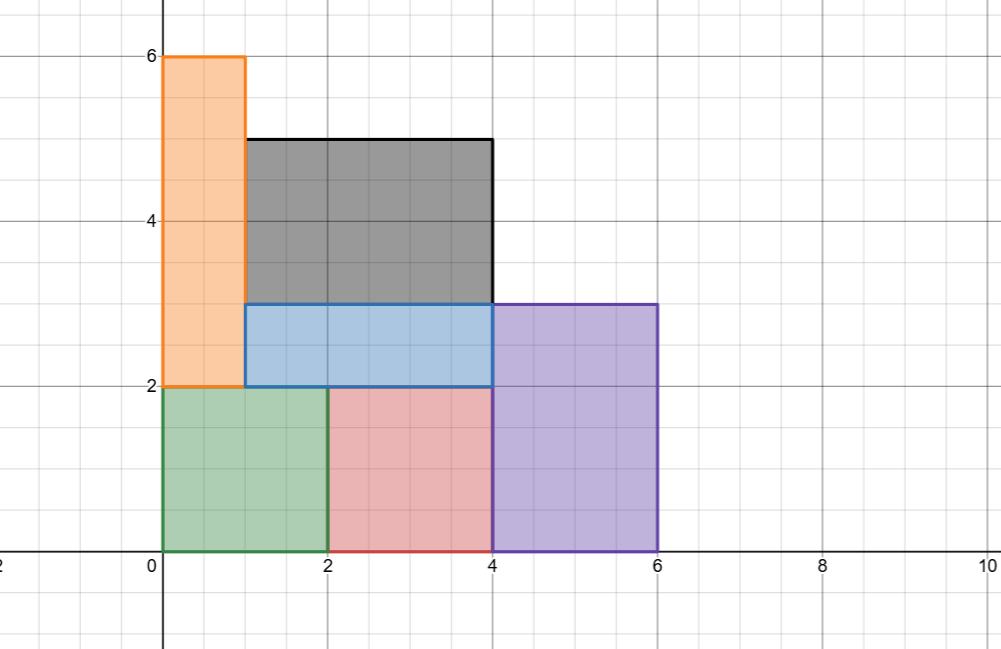
Component Placements:
Component 0: pos=(2.0, 0.0), size=2x2
Component 1: pos=(4.0, 0.0), size=2x3
Component 2: pos=(1.0, 3.0), size=3x2
Component 3: pos=(0.0, 0.0), size=2x2
Component 4: pos=(0.0, 2.0), size=1x4
Component 5: pos=(1.0, 2.0), size=3x1
Component Assignments:
Component 0 -> Bin 0, Layer 0
Component 1 -> Bin 1, Layer 0
Component 2 -> Bin 0, Layer 0
Component 3 -> Bin 0, Layer 0
Component 4 -> Bin 0, Layer 0
Component 5 -> Bin 0, Layer 0
Bin usage: {0: 5, 1: 1}
Bins used: 2
ALL OPTIMAL VARIABLE VALUES
alpha_(0,_1) = 0.0000
alpha_(0,_2) = 0.0000
alpha_(0,_3) = 0.0000
alpha_(0,_4) = 0.0000
alpha_(0,_5) = 0.0000
alpha_(1,_0) = 0.0000
alpha_(1,_2) = 0.0000
alpha_(1,_3) = 0.0000
alpha_(1,_4) = 0.0000
alpha_(1,_5) = 0.0000
alpha_(2,_0) = 0.0000
alpha_(2,_1) = 0.0000
alpha_(2,_3) = 0.0000
alpha_(2,_4) = 0.0000
alpha_(2,_5) = 0.0000
alpha_(3,_0) = 1.0000
alpha_(3,_1) = 0.0000
alpha_(3,_2) = 0.0000
alpha_(3,_4) = 0.0000
alpha_(3,_5) = 0.0000
alpha_(4,_0) = 1.0000
alpha_(4,_1) = 0.0000
alpha_(4,_2) = 1.0000
alpha_(4,_3) = 0.0000
alpha_(4,_5) = 1.0000
alpha_(5,_0) = 0.0000
alpha_(5,_1) = 1.0000
alpha_(5,_2) = 0.0000
alpha_(5,_3) = 0.0000
alpha_(5,_4) = 0.0000
aux_theta_omega_(0,_0) = 5.0000
aux_theta_omega_(1,_0) = 1.0000
beta_(0,_1) = 0.0000
beta_(0,_2) = 1.0000
beta_(0,_3) = 0.0000
beta_(0,_4) = 0.0000
beta_(0,_5) = 1.0000
beta_(1,_0) = 0.0000
beta_(1,_2) = 0.0000
beta_(1,_3) = 0.0000
beta_(1,_4) = 0.0000
beta_(1,_5) = 0.0000
beta_(2,_0) = 0.0000
beta_(2,_1) = 0.0000
beta_(2,_3) = 0.0000
beta_(2,_4) = 0.0000
beta_(2,_5) = 0.0000
beta_(3,_0) = 0.0000
beta_(3,_1) = 0.0000
beta_(3,_2) = 1.0000
beta_(3,_4) = 1.0000
beta_(3,_5) = 1.0000
beta_(4,_0) = 0.0000
beta_(4,_1) = 0.0000
beta_(4,_2) = 0.0000
beta_(4,_3) = 0.0000
beta_(4,_5) = 0.0000
beta_(5,_0) = 0.0000
beta_(5,_1) = 0.0000
beta_(5,_2) = 1.0000
beta_(5,_3) = 0.0000
beta_(5,_4) = 0.0000
mu_(0,_0,_0) = 1.0000
mu_(0,_1,_0) = 0.0000
mu_(1,_0,_0) = 0.0000
mu_(1,_1,_0) = 1.0000
mu_(2,_0,_0) = 1.0000
mu_(2,_1,_0) = 0.0000
mu_(3,_0,_0) = 1.0000
mu_(3,_1,_0) = 0.0000
mu_(4,_0,_0) = 1.0000
mu_(4,_1,_0) = 0.0000
mu_(5,_0,_0) = 1.0000
mu_(5,_1,_0) = 0.0000
omega_(0,_0) = 1.0000
omega_(1,_0) = 1.0000
same_bin_(0,_1) = 0.0000
same_bin_(0,_2) = 1.0000
same_bin_(0,_3) = 1.0000
same_bin_(0,_4) = 1.0000
same_bin_(0,_5) = 1.0000
same_bin_(1,_2) = 0.0000
same_bin_(1,_3) = 0.0000
same_bin_(1,_4) = 0.0000
same_bin_(1,_5) = 1.0000
same_bin_(2,_3) = 1.0000
same_bin_(2,_4) = 1.0000
same_bin_(2,_5) = 1.0000
same_bin_(3,_4) = 1.0000
same_bin_(3,_5) = 1.0000
same_bin_(4,_5) = 1.0000
theta_(0,_0) = 5.0000
theta_(1,_0) = 1.0000
x_0 = 2.0000
x_1 = 4.0000
x_2 = 1.0000
x_3 = 0.0000
x_4 = 0.0000
x_5 = 1.0000
y_0 = 0.0000
y_1 = 0.0000
y_2 = 3.0000
y_3 = 0.0000
y_4 = 2.0000
y_5 = 2.0000
Total variables: 105
Objective value: 15.0000
Conclusion
The problem considered in this homework was definitely solved. However, the problem at question is, unfortunately, quite a rudimentary version of what can actually be used when solving real-life problems.
Using plain linear programming is insufficient to solve these kinda problems in reasonable time, and increasing the number of components or bins leads to an exponential rise in complexity and time required to solve it.
Nevertheless, it was reasonably fun to try and consider all the endless constraints required to solve even a crude version of a circuit optimization problem. It successfully positioned these components on a grid (which is a reduced version of a circuit board, after all), packing all the components very close to each other and not leaving any gaps. I would consider this a massive success.
Visualization for the example considered in the work.